To: To the UK Government, Parliament, Competition and Markets Authority, and consumer-protection authorities:
Buy it, Own it
Buy it, own it.
Protect consumers' right to own what they buy
Protect consumers' right to own what they buy
Why is this important?
Petition: Stop Turning Ownership Into a Subscription
Protect consumers' right to own what they buy
To the UK Government, Parliament, Competition and Markets Authority, and consumer-protection authorities:
At one point, my monthly subscriptions had reached 50% of my income, and something had to change. I simply couldn't afford it anymore. Once I cancelled them, I realised how much of my income had been going towards subscriptions, and I was left with almost nothing.
My experience reflects a wider problem: the growing practice of turning ownership into permanent rental.
We, the undersigned, call for stronger laws to protect consumers from being forced to pay recurring subscriptions for functionality they have already purchased.
We believe that buying something should mean owning it.
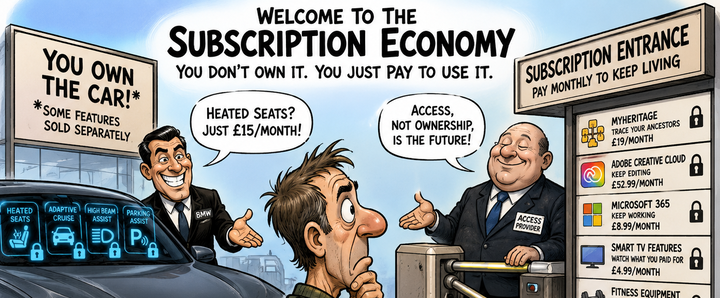
Consumers are increasingly paying thousands of pounds for cars, appliances, technology and other products, only to discover that some functions are controlled by software and can only be accessed through an ongoing subscription.
Hardware may already be physically installed in a product, yet consumers can be required to keep paying to use it.
This represents a fundamental shift from ownership to permanent rental.
We recognise that genuine ongoing services can legitimately require subscriptions. Streaming, cloud storage, continuously updated navigation and similar services involve continuing costs.
However, consumers should not be forced to pay indefinitely for functionality that is already physically present in a product they have purchased and does not genuinely require an ongoing service.
We therefore call on the Government to introduce stronger consumer protections:
1. Consumers should own the functionality they purchase
Where hardware or functionality is included in the purchase price, manufacturers should not be permitted to disable it solely because a consumer refuses to pay a recurring subscription.
Where a feature can operate without an ongoing service, consumers should have the option of purchasing permanent access.
2. No "subscription lock" on paid-for hardware
Manufacturers should not use software or digital restrictions to turn already-installed, paid-for hardware into a subscription-only feature without making this exceptionally clear before purchase.
Consumers must know exactly what they are buying.
3. Permanent purchase options should be available where technically possible
If a subscription unlocks functionality that does not genuinely require an ongoing service, consumers should also be offered a reasonable one-off purchase option.
4. Ownership should survive the end of a subscription
Products should remain reasonably functional when a subscription expires. Manufacturers should not be able to make an expensive physical product unnecessarily useless simply because a consumer stops paying a recurring fee.
5. Second-hand ownership must be protected
When a product is sold, the new owner should receive the functionality included in the original purchase, except where genuinely ongoing services are required.
Digital restrictions should not undermine the traditional ability to buy, sell and use second-hand goods.
6. Subscriptions must require genuine, informed consent
Consumers should not unknowingly move from a free trial, introductory offer or fixed-term purchase into an expensive recurring contract.
The price, renewal date, minimum commitment and cancellation conditions must be clearly displayed before purchase.
7. Cancellation must be as easy as subscribing
If a subscription can be started online in a few clicks, consumers should be able to cancel it online in a similarly simple way.
Companies should not use complicated procedures, lengthy telephone queues, hidden processes or unnecessary obstacles to discourage cancellation.
8. Automatic renewal must not become an indefinite licence to take money
Consumers should receive clear and timely reminders before significant renewals and price increases. Where appropriate, active confirmation should be required rather than assuming continued consent because a consumer forgot a renewal date.
9. Consumers must be protected from "dark patterns"
Companies should not deliberately design websites or applications so that subscribing is easy while cancellation is confusing, hidden or unnecessarily difficult.
10. Regulators should investigate subscription-based ownership
We call on the Competition and Markets Authority and other relevant regulators to investigate whether subscription-based access to already-purchased functionality creates unfair consumer practices, particularly in automotive, technology, software, appliances and digital information services.
Why this matters
The UK Government has estimated that approximately 9.7 million subscription contracts are unwanted, costing consumers around £1.6 billion every year.
The Government has recognised subscription traps as a consumer-protection problem and introduced measures intended to improve information, reminders and cancellation.
But the problem goes beyond unwanted subscriptions.
It is about the meaning of ownership itself.
We are moving towards a world where consumers can pay the full purchase price for a product while the manufacturer retains control over whether important functions can actually be used.
This raises a fundamental question:
If I have paid for the product, but must keep paying to use its functions, do I really own it?
We believe consumers deserve a clear answer.
BUY IT — OWN IT.
A subscription should pay for a genuine ongoing service.
It should not become a permanent toll booth between consumers and products they have already purchased.
We call on the UK Government and Parliament to strengthen consumer law so that:
If you buy it, you own it.
If you subscribe to a service, you pay for the service.
Companies should not be allowed to turn ownership into permanent rent simply because modern technology makes it possible.
We urge the Government to act now to protect the fundamental consumer right to own and use the products we buy.
Petitioner's principal demand
Introduce legislation preventing businesses from using subscriptions to restrict functionality that consumers have already purchased as part of a physical product, while strengthening transparency, informed consent, automatic-renewal, price-increase and cancellation protections for genuine subscription services.
Protect consumers' right to own what they buy
To the UK Government, Parliament, Competition and Markets Authority, and consumer-protection authorities:
At one point, my monthly subscriptions had reached 50% of my income, and something had to change. I simply couldn't afford it anymore. Once I cancelled them, I realised how much of my income had been going towards subscriptions, and I was left with almost nothing.
My experience reflects a wider problem: the growing practice of turning ownership into permanent rental.
We, the undersigned, call for stronger laws to protect consumers from being forced to pay recurring subscriptions for functionality they have already purchased.
We believe that buying something should mean owning it.
Consumers are increasingly paying thousands of pounds for cars, appliances, technology and other products, only to discover that some functions are controlled by software and can only be accessed through an ongoing subscription.
Hardware may already be physically installed in a product, yet consumers can be required to keep paying to use it.
This represents a fundamental shift from ownership to permanent rental.
We recognise that genuine ongoing services can legitimately require subscriptions. Streaming, cloud storage, continuously updated navigation and similar services involve continuing costs.
However, consumers should not be forced to pay indefinitely for functionality that is already physically present in a product they have purchased and does not genuinely require an ongoing service.
We therefore call on the Government to introduce stronger consumer protections:
1. Consumers should own the functionality they purchase
Where hardware or functionality is included in the purchase price, manufacturers should not be permitted to disable it solely because a consumer refuses to pay a recurring subscription.
Where a feature can operate without an ongoing service, consumers should have the option of purchasing permanent access.
2. No "subscription lock" on paid-for hardware
Manufacturers should not use software or digital restrictions to turn already-installed, paid-for hardware into a subscription-only feature without making this exceptionally clear before purchase.
Consumers must know exactly what they are buying.
3. Permanent purchase options should be available where technically possible
If a subscription unlocks functionality that does not genuinely require an ongoing service, consumers should also be offered a reasonable one-off purchase option.
4. Ownership should survive the end of a subscription
Products should remain reasonably functional when a subscription expires. Manufacturers should not be able to make an expensive physical product unnecessarily useless simply because a consumer stops paying a recurring fee.
5. Second-hand ownership must be protected
When a product is sold, the new owner should receive the functionality included in the original purchase, except where genuinely ongoing services are required.
Digital restrictions should not undermine the traditional ability to buy, sell and use second-hand goods.
6. Subscriptions must require genuine, informed consent
Consumers should not unknowingly move from a free trial, introductory offer or fixed-term purchase into an expensive recurring contract.
The price, renewal date, minimum commitment and cancellation conditions must be clearly displayed before purchase.
7. Cancellation must be as easy as subscribing
If a subscription can be started online in a few clicks, consumers should be able to cancel it online in a similarly simple way.
Companies should not use complicated procedures, lengthy telephone queues, hidden processes or unnecessary obstacles to discourage cancellation.
8. Automatic renewal must not become an indefinite licence to take money
Consumers should receive clear and timely reminders before significant renewals and price increases. Where appropriate, active confirmation should be required rather than assuming continued consent because a consumer forgot a renewal date.
9. Consumers must be protected from "dark patterns"
Companies should not deliberately design websites or applications so that subscribing is easy while cancellation is confusing, hidden or unnecessarily difficult.
10. Regulators should investigate subscription-based ownership
We call on the Competition and Markets Authority and other relevant regulators to investigate whether subscription-based access to already-purchased functionality creates unfair consumer practices, particularly in automotive, technology, software, appliances and digital information services.
Why this matters
The UK Government has estimated that approximately 9.7 million subscription contracts are unwanted, costing consumers around £1.6 billion every year.
The Government has recognised subscription traps as a consumer-protection problem and introduced measures intended to improve information, reminders and cancellation.
But the problem goes beyond unwanted subscriptions.
It is about the meaning of ownership itself.
We are moving towards a world where consumers can pay the full purchase price for a product while the manufacturer retains control over whether important functions can actually be used.
This raises a fundamental question:
If I have paid for the product, but must keep paying to use its functions, do I really own it?
We believe consumers deserve a clear answer.
BUY IT — OWN IT.
A subscription should pay for a genuine ongoing service.
It should not become a permanent toll booth between consumers and products they have already purchased.
We call on the UK Government and Parliament to strengthen consumer law so that:
If you buy it, you own it.
If you subscribe to a service, you pay for the service.
Companies should not be allowed to turn ownership into permanent rent simply because modern technology makes it possible.
We urge the Government to act now to protect the fundamental consumer right to own and use the products we buy.
Petitioner's principal demand
Introduce legislation preventing businesses from using subscriptions to restrict functionality that consumers have already purchased as part of a physical product, while strengthening transparency, informed consent, automatic-renewal, price-increase and cancellation protections for genuine subscription services.