
To: UK Government
“Switch the Rosette, Face the Voters: No Mandate Without a Re-Vote.”
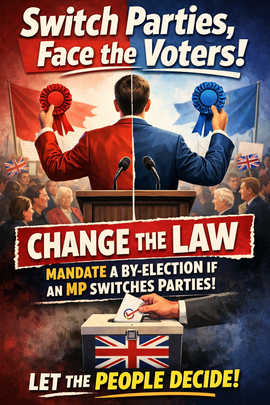
We call for a change in the law requiring any Member of Parliament who changes political party during their term of office to automatically trigger a by-election in their constituency.
If an MP was elected under one party’s manifesto and later chooses to represent another, they must seek renewed approval from their constituents.
This reform would protect democratic accountability and ensure that voters — not politicians — decide who represents them and under which banner.
This reform would protect democratic accountability and ensure that voters — not politicians — decide who represents them and under which banner.
Why is this important?
Arguments for Triggering a By-Election When an MP Switches Parties
1. The Mandate Belongs to the Voters — Not the Individual
In UK general elections, most voters cast their ballot for a party platform as much as for a person. Campaign leaflets, manifestos, televised debates, and doorstep promises are all party-branded.
If an MP switches allegiance mid-term, they are no longer representing the manifesto voters endorsed.
A by-election restores democratic consent.
2. Manifesto Commitments Matter
Voters choose between competing visions — tax, public services, immigration, defence, welfare.
When an MP changes parties, they may also change policy positions.
Without a by-election, constituents are effectively represented by policies they explicitly voted against.
A re-vote ensures policy alignment with public will.
3. Trust in Politics Is Fragile
Public confidence in politics is already low. Party switching can appear opportunistic or career-driven — fair or not.
Requiring a by-election:
- Demonstrates accountability
- Removes suspicion of personal gain
- Strengthens democratic legitimacy
It says: “If I believe this is right, I trust my constituents to agree.”
4. It Protects Democratic Stability
Party balance in Parliament affects:
- Government majorities
- Confidence votes
- Legislative outcomes
If multiple MPs switch without electoral endorsement, it can materially alter the political landscape voters chose.
A by-election ensures Parliament reflects current consent, not internal political manoeuvring.
5. It Encourages Principle Over Convenience
If an MP genuinely believes their original party no longer reflects their values, that is honourable.
But honour is completed by seeking renewed approval from constituents.
Conviction should withstand scrutiny at the ballot box.
6. It Aligns Representation With Consent
The UK operates on representative democracy — but representation must rest on ongoing legitimacy.
Switching parties without voter approval risks undermining that principle.
A by-election renews the social contract.
7. It Creates a Clear Democratic Standard
Rather than public outrage, media pressure, or selective resignations, a rule requiring a by-election would:
- Remove ambiguity
- Apply equally to all parties
- Prevent tactical defections
Clarity strengthens fairness.
Closing Line
If an MP believes they can change colours and still carry the same mandate —
then they should have nothing to fear from returning to the people who lent it to them.
Switch the party. Face the public. Let democracy decide.