To: UK Government, DWP, Employment Agency Standards Inspectorate (EAS), Equality and Human Rights Commission (EHRC), Advertising Standards Authority (ASA),
Make it compulsory for job vacancy ads to contain the actual salary (or range)
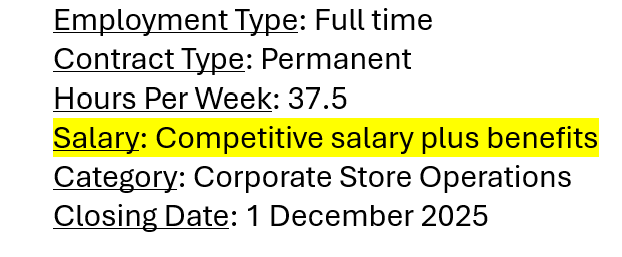
I am campaigning to make it compulsory for any job vacancy ad, wherever it is published, and whatever level the job is at, to include the actual salary, or at the very least the salary range. Just saying "Competitive" is not sufficient and also can mislead candidates about the seniority of a role. It's a deeply unfair practice that wastes both recruiters' and applicants' time.
Why is this important?
Thousands of jobseekers waste an inordinate amount of time, energy and emotional investment into applying for jobs based on the role description only to find out at interview stage - if they are lucky - that the salary is a lot less than they were expecting based on the job description, or that the job is, on the contrary, too senior for their experience.
Advertising the salary range upfront gives a candidate an idea of the seniority of the role. I have spoken over the past 15 years with both candidates and companies who complained of application mismatches, where people are under- or overqualified for a role because they couldn't tell from the ad how junior or senior the role was. I experienced this myself, made worse by the fact that various companies use different terminologies for job titles, so you can't even judge by that.
This would also stop the unfair practice of asking candidates "What are your salary expectations for this role?" or similar questions, which are designed to save a company money but disadvantage the applicant. Experience shows that in most cases people will quote lower salary expectations, especially if they are desperate for a job, and even if the company's salary range for that role was higher, most won't admit that once the candidate has expressed an expectation that is lower than what the firm had in mind.
My own example:
I'd worked for over 25 years for a large financial institution, in mid-senior roles, before I was made redundant in 2024, and I have so far been unsuccessful at securing another role, despite my experience and qualifications.
One of the reasons for a number of applications was being asked questions like what was my last salary or what my expectations were, and even when I quoted less - in some cases even £20-25K less! - than my previous salary, I could tell from the questions - even when I pre-empted them - that they were afraid I'd 'walk' as soon as I got offered more somewhere else.
They would avoided a waste of both theirs and my time if they had simply put on the job advert what the salary was... In some cases, I wouldn't have even applied as the salary just wouldn't have worked for my financial circumstances. In one case, they seemed reluctant to negotiate fewer than 3 days in the office and as I don't drive, this would have been a huge drain (£260/month on taxis, as otherwise it would mean two buses and some walking and i have some mobility issues), only on getting to work. It was very upsetting when I got the email after the interview, as I almost knew they weren't going to offer me the job! After all the prep, research, tailoring of the CV and application...
The obligation to include salary on job ads and making it as illegal as asking protected characteristics questions to ask about previous salary at application/interview stage should be included also in the new Employment Rights Act 2025.
Advertising the salary range upfront gives a candidate an idea of the seniority of the role. I have spoken over the past 15 years with both candidates and companies who complained of application mismatches, where people are under- or overqualified for a role because they couldn't tell from the ad how junior or senior the role was. I experienced this myself, made worse by the fact that various companies use different terminologies for job titles, so you can't even judge by that.
This would also stop the unfair practice of asking candidates "What are your salary expectations for this role?" or similar questions, which are designed to save a company money but disadvantage the applicant. Experience shows that in most cases people will quote lower salary expectations, especially if they are desperate for a job, and even if the company's salary range for that role was higher, most won't admit that once the candidate has expressed an expectation that is lower than what the firm had in mind.
My own example:
I'd worked for over 25 years for a large financial institution, in mid-senior roles, before I was made redundant in 2024, and I have so far been unsuccessful at securing another role, despite my experience and qualifications.
One of the reasons for a number of applications was being asked questions like what was my last salary or what my expectations were, and even when I quoted less - in some cases even £20-25K less! - than my previous salary, I could tell from the questions - even when I pre-empted them - that they were afraid I'd 'walk' as soon as I got offered more somewhere else.
They would avoided a waste of both theirs and my time if they had simply put on the job advert what the salary was... In some cases, I wouldn't have even applied as the salary just wouldn't have worked for my financial circumstances. In one case, they seemed reluctant to negotiate fewer than 3 days in the office and as I don't drive, this would have been a huge drain (£260/month on taxis, as otherwise it would mean two buses and some walking and i have some mobility issues), only on getting to work. It was very upsetting when I got the email after the interview, as I almost knew they weren't going to offer me the job! After all the prep, research, tailoring of the CV and application...
The obligation to include salary on job ads and making it as illegal as asking protected characteristics questions to ask about previous salary at application/interview stage should be included also in the new Employment Rights Act 2025.