1,000 signatures reached
To: Plus Dane Housing
Please Help Save My Tiny Accessible Garden - A Lifeline For A Disabled NHS Worker
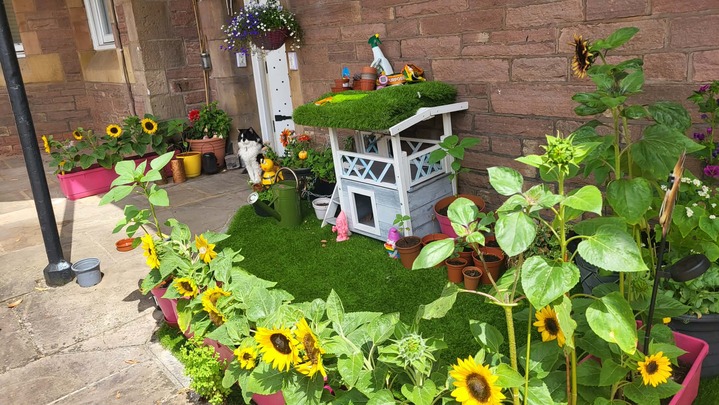
Please let me keep my tiny accessible garden. As a disabled NHS worker, it is a lifeline for me. Please don't make me remove it.
Why is this important?
I am asking for your support to help save my tiny 165cm x 70cm garden outside my front door. My housing association has given me just 12 days to remove it after a single complaint. To many people it may look like a few pots and some artificial grass. To me, it is my lifeline.
I live with multiple long-term disabilities, including Classical Ehlers-Danlos syndrome, Spina Bifida, M.E., Fibromyalgia, Endometriosis, ADHD, anxiety and depression. I work just 15 hours a week for the NHS because that is all my health allows. The remaining 149 hours each week I spend mostly at home.
My bed is in my living room, only a few steps from my front door. For the last ten years, the view from that door has been an abandoned, mould-covered Peugeot that has been left to rot. The owner no longer even lives on this side of the building and parks their current car elsewhere, leaving this one untouched.
After years of looking at a decaying vehicle, I created a tiny wildlife garden. It gives me a reason to get out of bed on difficult days. Sometimes all I can manage is walking the few steps to my doorway to see what has bloomed or to watch the bees, butterflies and dragonflies that now visit every day.
It has also improved my safety.
Before I laid the artificial grass, loose gravel was regularly scattered outside my door by off-lead dogs. Because Ehlers-Danlos syndrome causes joint instability and I wear NHS-prescribed hinged knee braces, uneven gravel significantly increases my risk of falls. The plant pots have also stopped dogs fouling directly outside my entrance.
This tiny space has become part of my daily therapy. It encourages me to get fresh air, supports my mental health and gives me a sense of purpose during long periods confined to my home.
It has also meant a great deal to my mum, who is currently undergoing treatment for breast and lung cancer. Visiting my little garden after her hospital appointments has given us both moments of happiness during an incredibly difficult time.
Neighbours, NHS colleagues and visitors regularly tell me how much they enjoy seeing the flowers and wildlife. One complaint should not outweigh the positive impact this small garden has on so many people. The housing association havn't added any plants to the grounds or turned the soil in the bedding areas for 14 years.
I am not asking for special treatment.
I am asking for reasonable compassion and understanding for a disabled tenant whose tiny accessible garden improves both physical safety and mental wellbeing.
Please help me ask the housing association to allow this small garden to remain.
Sometimes something that seems insignificant to one person can mean everything to someone else.
Thank you for your time & help.
Ria
I live with multiple long-term disabilities, including Classical Ehlers-Danlos syndrome, Spina Bifida, M.E., Fibromyalgia, Endometriosis, ADHD, anxiety and depression. I work just 15 hours a week for the NHS because that is all my health allows. The remaining 149 hours each week I spend mostly at home.
My bed is in my living room, only a few steps from my front door. For the last ten years, the view from that door has been an abandoned, mould-covered Peugeot that has been left to rot. The owner no longer even lives on this side of the building and parks their current car elsewhere, leaving this one untouched.
After years of looking at a decaying vehicle, I created a tiny wildlife garden. It gives me a reason to get out of bed on difficult days. Sometimes all I can manage is walking the few steps to my doorway to see what has bloomed or to watch the bees, butterflies and dragonflies that now visit every day.
It has also improved my safety.
Before I laid the artificial grass, loose gravel was regularly scattered outside my door by off-lead dogs. Because Ehlers-Danlos syndrome causes joint instability and I wear NHS-prescribed hinged knee braces, uneven gravel significantly increases my risk of falls. The plant pots have also stopped dogs fouling directly outside my entrance.
This tiny space has become part of my daily therapy. It encourages me to get fresh air, supports my mental health and gives me a sense of purpose during long periods confined to my home.
It has also meant a great deal to my mum, who is currently undergoing treatment for breast and lung cancer. Visiting my little garden after her hospital appointments has given us both moments of happiness during an incredibly difficult time.
Neighbours, NHS colleagues and visitors regularly tell me how much they enjoy seeing the flowers and wildlife. One complaint should not outweigh the positive impact this small garden has on so many people. The housing association havn't added any plants to the grounds or turned the soil in the bedding areas for 14 years.
I am not asking for special treatment.
I am asking for reasonable compassion and understanding for a disabled tenant whose tiny accessible garden improves both physical safety and mental wellbeing.
Please help me ask the housing association to allow this small garden to remain.
Sometimes something that seems insignificant to one person can mean everything to someone else.
Thank you for your time & help.
Ria